




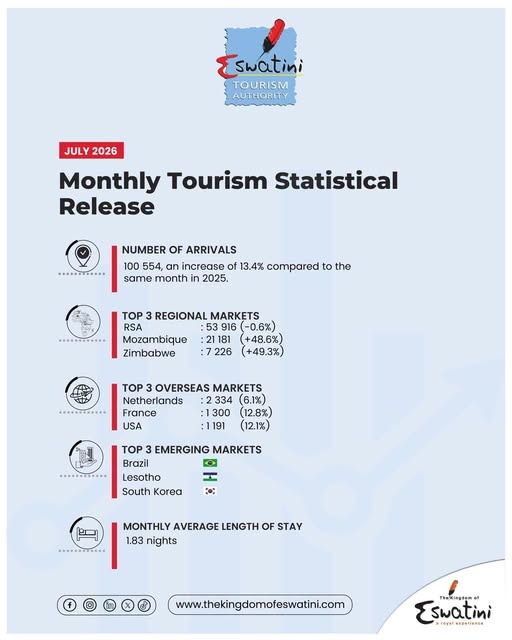
The Kingdom of Eswatini recorded 100,554 international visitor arrivals in July 2026, representing a 13.4% increase from the 88,707 arrivals recorded in July 2025. The increase of 11,847 visitors marks the first time in 2026 that monthly international visitor arrivals surpassed the 100,000 mark, reflecting continued positive momentum in inbound travel.
Growth was recorded across all major world regions, with the Middle East registering the strongest percentage increase at 46.5%, followed by Africa at 14.8% and the Americas at 11.4%. Europe and Asia & the Pacific recorded more moderate growth of 1.7% and 1.6%, respectively. Africa remained the dominant source region, accounting for 88.8% of total international visitor arrivals.
Regional markets continued to underpin Eswatini’s inbound tourism performance, with Mozambique making a particularly important contribution to the growth in arrivals. The increase in visitors from Mozambique reflects the continued strength of regional tourism linkages and presents opportunities to further convert cross-border demand into overnight stays, tourism expenditure and participation in local tourism experiences. Arrivals from other neighbouring markets, including Zimbabwe, Malawi and Lesotho, also contributed to the overall increase. It is important to note, however, that substantial volumes of travellers from Zimbabwe and Malawi were transit-related, and therefore do not necessarily translate into equivalent levels of tourism consumption within Eswatini.



Overall, the July results present a positive picture of continued growth in international visitor arrivals, while also highlighting the importance of looking beyond headline volumes to understand the economic contribution of different visitor markets. The strong performance of Mozambique is particularly encouraging from a tourism perspective and reinforces the opportunity to deepen regional markets while strengthening initiatives that encourage visitors to stay longer, spend more and engage with Eswatini’s tourism products.
The strong performance of these regional markets highlights the continued importance of regional tourism in driving Eswatini’s inbound tourism growth, while the positive contribution from overseas markets points to continued opportunities to diversify the country’s international visitor base.
Regional and Overseas Performance
Africa
Africa, the cornerstone of Eswatini’s inbound tourism sector, accounted for approximately 88.8% of total international visitor arrivals, with arrivals from the region increasing from 77,801 in July 2025 to 89,320 in July 2026, representing 14.8% year-on-year growth.
Within the African market, Mozambique recorded the strongest absolute gain, with arrivals increasing from 14,258 to 21,181 in July 2026, representing a 48.6% increase. Other regional markets also recorded notable increases, including Lesotho (114.3%), Botswana (26.1%), Zambia (11.0%) and Tanzania (6.7%). These gains demonstrate the continued strength of regional travel and the importance of neighbouring and nearby markets in supporting inbound tourism growth.
South Africa remained Eswatini’s largest individual source market, despite a marginal 0.6% decline in arrivals, from 54,244 in July 2025 to 53,916 in July 2026. Given the market’s substantial contribution to overall arrivals, its performance remains an important consideration in assessing the broader trajectory of Eswatini’s tourism sector.
Overall, the July results point to continued resilience in regional tourism demand, supported by growth across several African markets. The performance also highlights opportunities to translate increased regional mobility into stronger tourism outcomes, particularly through initiatives that encourage longer stays and higher visitor expenditure.
Americas
Visitor arrivals from the Americas rose by 11.4% during the review period. The United States of America, the leading source market in the region, recorded a 12.1% rise, while Brazil experienced a modest increase of 3.8%. Canada, also continued the trend with a 1.6% increase, adding to the regional gains.






Asia & The Pacific
The Asia & the Pacific region recorded modest growth of 1.6%, with arrivals increasing from 2,387 in July 2025 to 2,426 in July 2026. Performance among individual markets was mixed. Pakistan recorded a 6.1% increase, while South Korea and Australia increased by 44.4% and 9.3%, respectively. These gains were partly offset by declines from China, India and the Philippines, which decreased by 5.2%, 2.0% and 46.5%, correspondingly.
Middle East
The Middle East recorded the highest percentage growth among all regions in July 2026, increasing by 46.5% year-on-year. However, the region remains a relatively minor source market for Eswatini, and the increase therefore translated into a comparatively limited contribution to total inbound arrivals. The growth was largely supported by Israel, where arrivals increased by 130.9%, while other Middle Eastern markets recorded mixed performance, including declines.
Europe
Visitations from Europe increased by 1.7% in July 2026, with most key markets recording growth, although the United Kingdom and Belgium registered declines. This performance partly reflects increased outbound travel from Europe during the summer holiday season, when school holidays typically support higher international travel demand.
Several European markets recorded notable growth during the month. Norway registered the strongest increase at 104.3%, followed by Sweden at 50.1%, Italy at 29.6%, France at 12.8% and the Netherlands at 6.1%. Germany also recorded a modest increase of 1.8%, indicating generally positive movement across several established European markets despite the overall regional growth remaining moderate.
Year-to-date performance
The year-to-date performance remained strongly anchored in the African market, with arrivals from the region increasing by 10.0% to 602,938 during the first seven months of 2026. South Africa remained the largest source market with 370,082 arrivals, followed by Mozambique with 141,133. Collectively, the African market accounted for approximately 90.9% of total international visitor arrivals during the period, underscoring the continued importance of regional travel to Eswatini’s inbound tourism performance.
The concentration of arrivals within the regional market was further reflected in the comparatively subdued performance of overseas source regions. During the review period, arrivals from Asia & the Pacific increased by 4.8%, while the Americas declined by 0.8% and Europe by 1.1%. The Middle East recorded the largest contraction among the major regions, with arrivals declining by 11.5%.
Overall, the year-to-date performance indicates that Eswatini’s inbound tourism growth continued to be supported predominantly by regional markets, while overseas markets remained relatively subdued. This pattern highlights the resilience of shorter-haul travel while also pointing to the continued potential to strengthen long-haul markets as air connectivity, travel costs, economic conditions and international travel confidence improve.