



The Financial Services Regulatory Authority (FSRA) has launched a youth-focused skit competition aimed at using creativity, storytelling and performance to strengthen public awareness about investment scams and digital deception.
The competition forms part of the FSRA’s activities for the International Organization of Securities Commissions (IOSCO) World Investor Week 2026 and is being held under the theme “Investment – Digital Deception and Scams.”
Young EmaSwati between the ages of 13 and 25 who reside in Eswatini are being encouraged to form teams, write, act and film an original 90-second dramatic performance highlighting the dangers of investment scams and ways members of the public can protect themselves.




According to the competition guidelines, teams must consist of between three and five cast members. Entries can be produced in English or siSwati and must be original works created specifically for the FSRA’s IOSCO World Investor Week entry.
The initiative comes at a time when digital platforms have become an increasingly important part of how people communicate, access information and make financial decisions. While technology has created greater access to financial information and investment opportunities, it has also provided scammers with new ways of targeting unsuspecting members of the public.
Through the competition, the FSRA is seeking to turn young people into advocates for investor protection by encouraging them to communicate important financial messages in a format that is engaging and easily understood.
FSRA Customer Experience Manager Lindokuhle Mthupha said for the skit competition, the same principle of learning through engagement is reflected in the use of drama to communicate financial literacy messages.

“The aim is to use creativity as a powerful tool for financial education, particularly among young people, so that important messages about investor protection can be understood, shared and remembered,” Mthupha said.
The competition requires participants to produce a 90-second video, with a 10-second grace period allowed. Entries exceeding 100 seconds will automatically be disqualified.
The brains behind this competition are also placing emphasis on production standards. Participants are expected to ensure clear dialogue and audio, while music or background noise that makes speech difficult to understand will not be accepted.
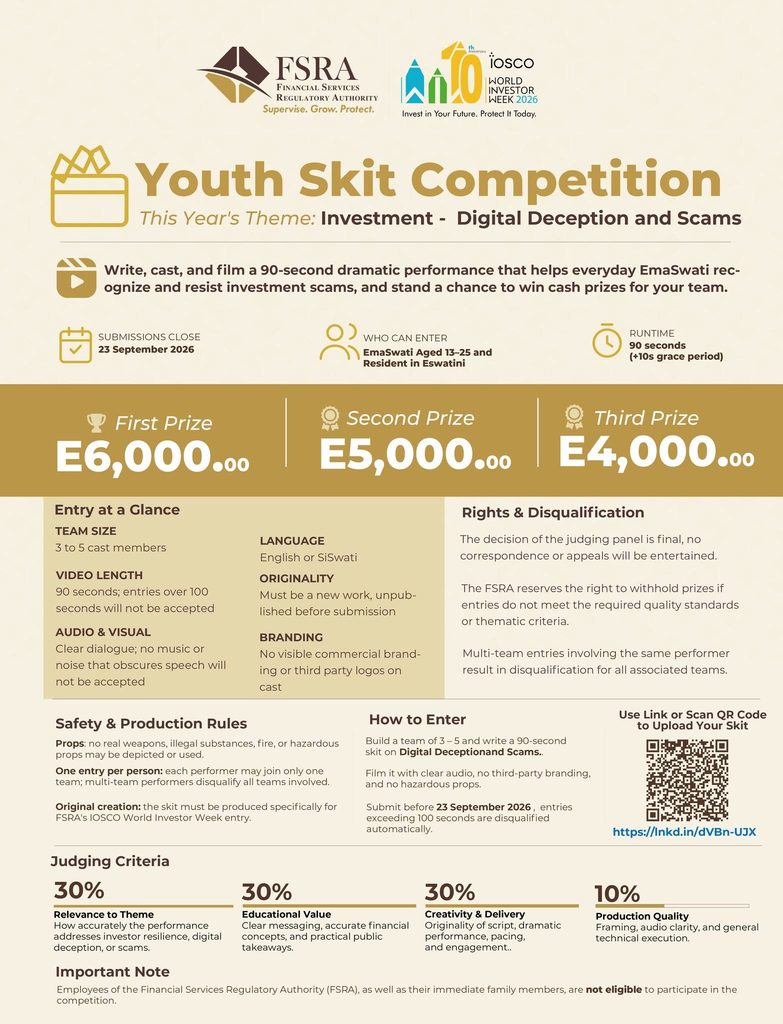
The use of commercial branding is also restricted. Entries may not contain visible commercial brands or third-party logos on the cast, while safety rules prohibit real weapons, illegal substances, fire and other hazardous props.
The competition offers significant financial incentives for the winning teams. The first-prize winner will receive E6,000, while the second- and third-placed teams will receive E5,000 and E4,000, respectively.
Judging will be based on four key areas. Relevance to the theme carries 30 per cent, with judges assessing how effectively a performance addresses investor resilience, digital deception or scams.
Another 30 per cent will be awarded for educational value, including clarity of the financial message, accuracy of concepts and practical takeaways for the public.
Creativity and delivery will account for a further 30 per cent, covering originality of the script, dramatic performance, pacing and audience engagement. The remaining 10 per cent will focus on production quality, including framing, audio clarity and overall technical execution.





The FSRA says the competition is designed not simply as an entertainment exercise, but as an opportunity for young people to contribute to the broader investor-protection conversation.
Investment scams can take many forms, including fraudulent online investment offers, fake trading platforms, impersonation, unrealistic promises of quick profits and schemes designed to obtain victims’ money or personal information. Digital deception can also make fraudulent opportunities appear legitimate through professionally designed websites, social media profiles, messaging applications and fabricated testimonials.
For young people, the competition therefore provides an opportunity to explore these issues from their own perspective and communicate warning signs to their peers, families and communities.
The authority is also encouraging participants to ensure that their work remains factual and responsible. The skits should educate audiences about recognising suspicious investment opportunities and making informed financial decisions rather than promoting specific commercial products.
Submissions close on September 23, giving aspiring filmmakers and performers a limited window to assemble their teams, develop scripts, rehearse and complete production.
The competition also reinforces the wider objectives of World Investor Week, which seeks to promote investor education, financial awareness and resilience among consumers.
For the FSRA, involving young people in the campaign creates an opportunity to take financial education beyond traditional presentations and turn it into relatable storytelling.
With cash prizes on offer and a topical theme centred on the growing threat of digital scams, the competition is expected to attract young creatives with interests in acting, filmmaking, writing and financial awareness.
The message from the initiative is straightforward: investment decisions require caution, information and verification.
By putting those lessons into the hands of young storytellers, the FSRA hopes the competition will produce entertaining performances while helping more EmaSwati recognise the warning signs of investment fraud and protect themselves from digital deception.